 https://whyy.org/articles/drexel-university-phasing-out-herbicides-pesticides-campus/
Weed killers prevent unwanted plants like crabgrass and dandelions from invading lawns. However, the chemicals found in such products can impact the environment if stormwater runoff carries them to local waterways. Research has found exposure to herbicides and pesticides may cause serious illnesses, including some cancers, among humans and animals. So, Drexel University’s groundskeepers will replace the synthetic chemicals campus-wide, with an organic turf program that includes organic fertilizer, overseeding and aeration. The decision comes after a group of students voiced concern about the use of weed killers. The decision was made following the success of a grant-funded pilot program using safer alternatives at the university’s Drexel Park. “With synthetic pesticides, fertilizers, and especially synthetic herbicides, there are risks that are just not entirely necessary, especially when there is such a great alternative available, which is organic turf care,” said Kacy Gao, a third-year student who helped advocate for the change. “I would hope that residents… just enjoy this space recreationally, knowing that it is not treated with synthetic herbicides.” The students partnered with environmental groups Toxic Free Philly and Re:wild Your Campus, which have been calling for institutions and governments to reduce pesticide and herbicide use. About 16 tons of toxic herbicides were sprayed in Philadelphia in 2022 alone, according to Toxic Free Philly. Researchers say every person in the U.S. has some level of pesticides in their blood or urine. Herbicides also are disproportionately sprayed in communities of color and low-income neighborhoods, according to The Black Institute. Though the data is limited, some studies suggest herbicides such as Roundup are associated with non-Hodgkin’s lymphoma and some other cancers, said Anneclaire De Roos, a professor at Drexel’s Dornsife School of Public Health. That has led to numerous lawsuits against the companies that manufacture the products, such as Monsanto.De Roos added that in addition to potentially contaminating waterways, herbicides can impact wildlife and the environment by reducing biodiversity and ecosystem functions. “[Using herbicide is] purely cosmetic on some place like a university campus. So the students, with their concern for the environment and health, and also for biodiversity and wildlife, that was the reason that they pushed for [an alternative],” she said. “The health concerns are there, and these are possible and probable carcinogens. But even beyond that, a push for this was ecological as well.” Landscapers say organic fertilizer doesn’t directly eliminate weeds, but it helps improve turf health. The healthier the grass, the more likely it can keep weeds out. Drexel’s groundskeepers say they’ve struggled to maintain grass coverage at Drexel Park, because it’s a popular spot for people to walk their dogs or play football with friends. The reduced grass has allowed unwanted weeds to take over the park, said Tony Gale, Drexel’s assistant director for grounds. Since using organic fertilizer at the park, grass health has improved, he said. Gale said he feels more comfortable using the safer alternative in such a populated area. “We used to [use herbicides] early on Saturday mornings, and it was very quiet around here. But still, you get the early jogger, an early dog walker. There’s always people out,” he said. “So, I’m just as happy to avoid that and not have anyone get sick or have anyone’s pet injured.”
0 Comments
Philadelphia jury awards $2.25 billion to man who claimed Roundup weed killer gave him cancer1/31/2024
The unanimous verdict issued Friday awarded John McKivison, 49, of Lycoming County, $250 million in compensatory damages, and $2 billion in punitive damages. The jury found that Roundup causes cancer, and that Monsanto was negligent and failed to warn consumers of the dangers of the product, said McKivison’s attorneys, Tom Kline of Kline & Specter in Philadelphia, and Jason Itkin of Houston-based Arnold & Itkin. “We are thankful that this unanimous jury found that Bayer/Monsanto’s Roundup was responsible for causing John McKivison’s blood cancer,” Kline and Itkin said in a statement. “The jury’s punitive damages award sends a clear message that this multi-national corporation needs top to bottom change.” McKivison’s attorneys said that he began using Roundup at his job at a warehouse when he was in his 20s. Because the product killed weeds effectively at his work, McKivison began spraying it regularly at his family’s home over the next two decades, his attorneys said. McKivison’s personal properties were as large as two acres, and he used the weed killer on food plots he and his family planted to attract wildlife. At one point, his attorneys said, he dispersed Roundup on his property from a tractor in 25- to 30-gallon loads. “The difference in his life, truly, is that he was exposed to Roundup,” Kline said. At issue in the case was the chemical glyphosate, Roundup’s active ingredient, as well as other ingredients in the weed killer. Monsanto developed glyphosate in 1974, and it has since become one of the most widely used herbicides worldwide, despite concerns that the chemical is carcinogenic. The lawsuit also named Nouryon, a Radnor-based chemical company that manufacturers another ingredient in Roundup known as a “surfactant” that helps the herbicide effectively kill weeds. World agencies have differed on glyphosate’s carcinogenic properties. In 2015, the International Agency for Research on Cancer, part of the World Health Organization, classified glyphosate as part of a group of chemicals that are “probably carcinogenic to humans.” It’s one of Europe’s major industrial players, but Bayer continues to struggle. It’s takeover of controversial seed- and chemicals-giant Monsanto in 2018 saddled it with billions in legal fees and payments from the pesticide known as "Roundup." New court judgments added to its woes this year – Bayer stock is down 30 percent from the beginning of 2023. Investors are growing restless. 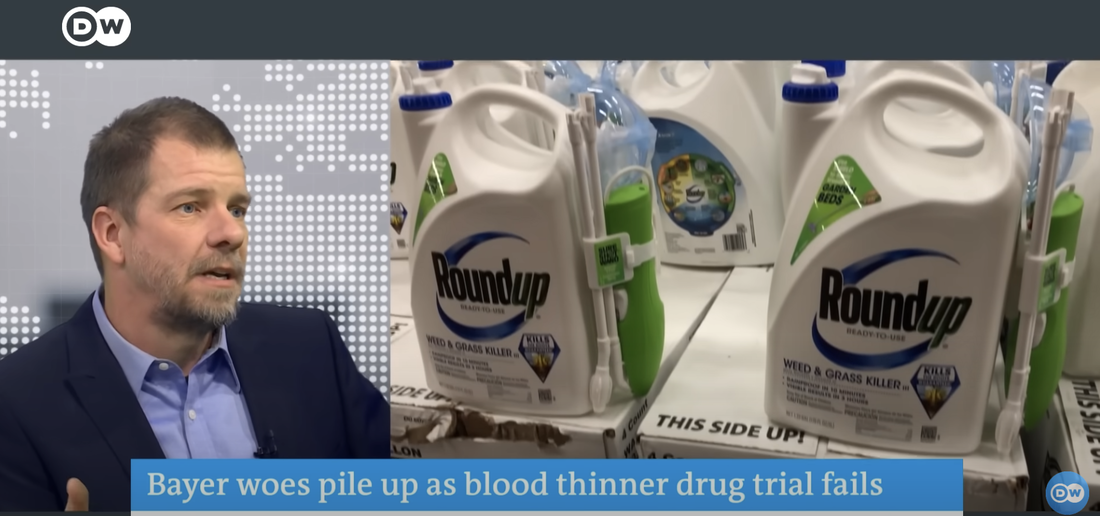 Into the Weeds is a Canadian documentary film, directed by Jennifer Baichwal and released in 2022. The film centres on Dewayne "Lee" Johnson, the California man whose health problems after longterm exposure to glyphosate in the herbicide product Roundup led to the landmark Johnson v. Monsanto Co. court case, which proved, using Monsanto's own internal documents obtained during discovery, that Monsanto knew of RoundUp's carcinogenic effects.
Rent or buy Into the Weeds on Amazon Stream Into the Weeds on Apple TV+ A Philadelphia court ruling earlier this month marks the fifth consecutive trial loss for pharmaceutical giant Bayer, whose Roundup weedkiller was named responsible for a Pennsylvania woman’s non-Hodgkin lymphoma.
Plaintiff Kelly Martel was awarded nearly $3.5 million in damages, a much smaller amount than other recent Bayer losses. In November, just three plaintiffs won $1.56 billion. Although amounts that high could be reduced because they exceed U.S. Supreme Court guidance, the verdicts represent a significant turn of fortune for Roundup users, hundreds of thousands of whom have sued Bayer for exposure to glyphosate, the weedkiller’s main ingredient. They say the herbicide gave them cancer, most notably non-Hodgkin lymphoma. Bayer won nine cases before their streak was broken in October with three losses in three states totaling more than $500 million. Martel’s lawsuit was actually against Nouryon Chemicals, its various subsidiaries, and Monsanto, not Bayer itself. Her lawyers contended that Nouryon created a chemical compound that enhanced Roundup’s cancer-causing properties. In a 10-2 split, the jury found Monsanto 92.5 percent liable for her injuries and Nouryon just 7.5 percent. “We disagree with the jury’s divided verdict and the modest damages award that conflicts with the overwhelming weight of scientific evidence and worldwide regulatory and scientific assessments, and believe that we have strong arguments on appeal to get this verdict overturned,” said Chris Loder, Bayer’s Head of External Relations. The Environmental Protection Agency (EPA) maintains that glyphosate is safe when used correctly, and in November, the European Union renewed its use for another ten years. The World Health Organization (WHO) classified glyphosate as a probable carcinogen in 2015. Although they were later found to have edited out evidence contradicting those results, independent research has reached similar conclusions. One 2019 study suggested that glyphosate exposure increases cancer risk by 41 percent. A new scientific paper published earlier this month found that pregnant women living near farm fields show “significantly” increased amounts of glyphosate in their urine while farmers are spraying the fields. The participants did not work with glyphosate; they only lived near farms that used it. These findings echo other recent research showing that gestational exposure to glyphosate is associated with reduced fetal growth and other in-utero problems. Bayer acquired Roundup in 2018 after purchasing Monsanto for $63 billion, to the vehement protest of some shareholders. Those shareholders are now putting pressure on Bayer to end the litigation, which company officials hoped might be possible during their nine-case winning streak. Bayer is currently facing about 50,000 Roundup lawsuits, even after agreeing in 2020 to pay nearly $10 billion to settle nearly 125,000 then-existing claims. Roundup lawsuits allege that the ingredients in the herbicide are harmful to human health and that Monsanto and Bayer either knew of these dangers and kept that knowledge from consumers or performed inadequate safety tests before releasing the product. A change in plaintiffs’ strategy could explain the shift in victories, as recent judges have allowed jurors to hear testimony not utilized in previous trials that Bayer calls improper evidence. “Plaintiffs are on a winning streak,” Nora Freeman Engstrom, a Stanford Law professor who studies mass tort actions, told the New York Times. She said the recent verdicts don’t bode well for Bayer because plaintiffs’ lawyers can use statements from prior testimony to build a stronger case over time. “With each trial, the playing field shifts subtly toward plaintiffs.” For example, jurors learned of a federal appeals court’s 2022 ruling that the EPA must reconsider its 2020 decision on glyphosate’s safety. Plaintiffs’ lawyers, as in Martel’s case, have also been focusing more on the theory that other ingredients in Roundup (e.g., known toxins like arsenic and formaldehyde) increase its carcinogenic potential. At least a dozen more Roundup trials are expected in 2024; Bayer has attempted to placate shareholders by pledging another $6.5 billion in reserved funds to settle those cases. But since the merger of Bayer and Monsanto was announced – even before Roundup litigation began – Bayer’s shares have fallen more than 60 percent. The company’s market capitalization is now worth approximately $33 billion, less than half of what it paid for Monsanto. Roundup has been the world’s most popular herbicide since Monsanto began selling it in 1974. Bayer has maintained that Roundup is safe and says it will continue to fight recent verdicts. The company has unsuccessfully attempted to end Roundup litigation via a Supreme Court ruling and Congressional bill. Bayer stopped selling Roundup for residential use in January 2023; it remains available for commercial and agricultural use. Roundup users who have developed cancer and believe it may be due to glyphosate exposure should contact an experienced Roundup lawyer to assess their eligibility for a claim. Glyphosate and 2,4-D Herbicide Use in Philadelphia Outdoor Spaces in 2022 by PPR
A provision in the HOPS bill requires Philadelphia Parks and Rec and all other government divisions that apply pesticides to public spaces to start keeping records of pesticide applications, which they were not doing previously to the passage of HOPS. TFP put in a right to know request for 2022's pesticide report, which was not made public. The request was granted and below is TFP's first analysis of the 10 page report. The total amount of glyphosate herbicide used: Approximately 61,000 fluid ounces or 3800 lbs - Contractors sprayed roughly 47,200 fluid ounces or 2925 lbs - PPR staff sprayed roughly 14,000 fluid ounces or 875 lbs. - The stated use of the large majority of glyphosate by PPR staff was for Ballfields, Building Perimeter Fence Lines, Trail and Forest Edges, Pavement Sidewalks, and Right of Way areas. - The stated use of glyphosate by Contractors was for Forest Restoration and Meadows. The total amount of 2,4-D herbicide used: 192,000 fluid ounces or 12,000 lbs. - The stated use of 2,4-D herbicide in 4 large applications by PPR staff was for Pavement. What are the Health Dangers Associated with Glyphosate in Our Food and Water? There is no established safe level of glyphosate. Independent studies have linked glyphosate to non-Hodgkin’s lymphoma, early deaths from Parkinson’s, liver and kidney disease and neurotoxicity. Industry tests on glyphosate reveal toxic effects, notably birth defects below the levels that regulators claimed showed no toxic effects. There is strong evidence that glyphosate can cause damage directly to DNA. Glyphosate has been shown to be a hormone disruptor. Hormone disruption in humans is thought to contribute to some cancers, birth defects, infertility, and developmental problems in fetuses, babies, and children. Exposure to pesticides adversely affects gut microbiome. A healthy microbiome is needed to develop a baby’s immune system which is needed to prevent cancers. According to a University of Washington study Roundup increases the risk of some cancers by more than 40%. Lawsuits Roundup has been indicted as a carcinogen in several prominent court cases. On 10/27/2023 a Philadelphia jury awarded $175 million after deciding an 83-year-old man got cancer from Roundup weed killer What does science say about the health risks of 2,4-D? The International Agency for Research on Cancer declared 2,4-D a possible human carcinogen, based on evidence that it damages human cells and, in a number of studies caused cancer in laboratory animals. 2,4-D was one of two active ingredients in the “Agent Orange” herbicide formulation used during the Vietnam War. The U.S Veterans Administration has determined 17 presumptive diseases that may be associated with Agent Orange and are eligible for compensation and treatment. These include: Non-Hodgkin’s Lymphoma, Multiple Myeloma, Parkinson’s Disease, Prostate Cancer, Thyroid Disease, Respiratory Cancers, and Peripheral Neuropathy to name some of the diseases on the list. Additionally it is associated with asthma, poor semen quality, birth defects and breast cancer. There is no established safe level of 2,4-D Children are uniquely vulnerable to the health effects of pesticide exposure. The Center for Disease Control and Prevention has found that children age 6-11 have higher levels of common pesticides in their bodies than adults . Many pesticides still widely used in the USA, at the level of tens to hundreds of millions of pounds annually, have been banned or are being phased out in the EU, China and Brazil. EPA failed to follow both the law and its own guidelines in determining whether glyphosate, the active ingredient in Roundup causes cancer, according to opinion.
|
AuthorWrite something about yourself. No need to be fancy, just an overview. Archives
June 2024
Categories |
 RSS Feed